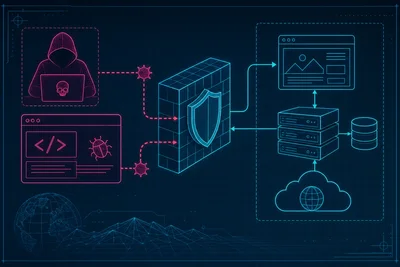
A web application firewall is not a set-it-and-forget-it tool. Attackers change their tactics constantly, and if the rules protecting your site don't change with them, you're left defending against threats that no longer exist while new ones walk right through the front door.
Think of it like antivirus software from ten years ago. It might still catch old viruses, but it has no idea what today's malware looks like. A web application firewall works the same way. Its rules are only as good as the last time someone updated them.
What Actually Happens Without Rule Updates
Every web application firewall works from a set of rules, sometimes called signatures, that describe what malicious traffic looks like. These rules flag suspicious patterns in requests: SQL injection attempts, cross-site scripting payloads, path traversal tricks, and dozens of other attack signatures.
The problem is that attackers actively test these rule sets. Once they find a way to slightly modify a payload so it slips past a known signature, they share that technique. It spreads fast. Within days, a bypass that worked on one site is being tried against thousands of others.
If your rule set hasn't been updated in months, you're not protected against:
- New CVEs disclosed in popular CMS platforms and plugins
- Fresh SQL injection variants designed to dodge pattern matching
- Emerging bot signatures used in credential stuffing campaigns
- Zero-day exploit patterns identified by security researchers
The OWASP Connection
Most reputable web application firewalls base their core rule sets on guidance from the OWASP Foundation, particularly the OWASP Top 10 list of common vulnerabilities. But OWASP itself revises this guidance periodically as attack trends shift. A firewall running on a three-year-old rule set is essentially defending against a three-year-old version of the threat landscape.
How Often Should Rules Actually Be Updated
There's no single magic number, but a reasonable baseline looks like this:
- Critical security patches: within hours of a major vulnerability disclosure
- Routine signature updates: weekly or biweekly
- Full rule set review: quarterly, to remove outdated rules and reduce false positives
If a major CMS like WordPress or a widely used plugin discloses a critical vulnerability, the window between disclosure and mass exploitation can be as short as 24 to 48 hours. Automated scanners start probing for the vulnerability almost immediately. Your web application firewall needs to have a matching rule in place before that window closes, not after.
Manual Updates vs. Managed Rule Sets
If you're running your own firewall configuration, you're responsible for tracking vulnerability disclosures, writing or sourcing new rules, testing them against your application, and deploying without breaking legitimate traffic. That's a real job, not a side task.
This is where a managed approach makes a practical difference. When a hosting provider manages the web application firewall for you, someone else is watching vulnerability feeds, updating rules across every protected site, and tuning them to avoid false positives. You benefit from updates the moment they're needed, without having to be the one tracking security bulletins at midnight. If you want to see how this looks in practice, our WAF overview covers how rule updates and traffic filtering work together on managed hosting.
Why This Beats a DIY Rule Set
A single site owner might catch one or two important disclosures a year. A team managing rules across thousands of sites sees attack patterns emerging in real time, often before they hit mainstream security news. That volume of visibility is nearly impossible to replicate on your own, and it's one of the practical differences between a WAF you configure once and one that's actively maintained.
False Positives Are Part of the Maintenance Cycle
Updating rules isn't only about adding new protections. It's also about removing or adjusting rules that are too aggressive. An outdated rule can block legitimate traffic just as easily as it blocks an attack, which means poor rule maintenance can cost you real visitors and customers, not just let bad ones through.
Good rule maintenance involves reviewing logs regularly to catch these situations early, adjusting rules based on your specific application's traffic patterns, and testing changes in a safe environment before pushing them live. This is exactly why a staging environment is valuable when you're making any security-related change to a production site. You can test rule adjustments without risking downtime for real visitors.
What to Ask About Your Current Protection
If you're evaluating whether your current setup is actually keeping you safe, ask these questions:
- How often are the rule sets updated, and by whom?
- Is there a documented process for responding to newly disclosed vulnerabilities?
- Can you see logs of what's being blocked, and adjust rules yourself if needed?
- Does the provider track OWASP guidance and CVE databases actively?
If the honest answer to any of these is "we're not sure," that's worth digging into further. We've written before about how to tell if a provider's protection is real or just marketing, and the same scrutiny applies here.
The Bottom Line
A web application firewall is only as strong as its most recent update. Static rule sets age quickly, and attackers are counting on the fact that most site owners never think to check. Whether you manage your own rules or rely on your host to do it, the real question isn't whether you have a firewall. It's whether that firewall is being actively maintained against threats that exist today, not the ones from last year. For a deeper look at how these rules get built and prioritized, see our post on how WAF rules decide what to block.