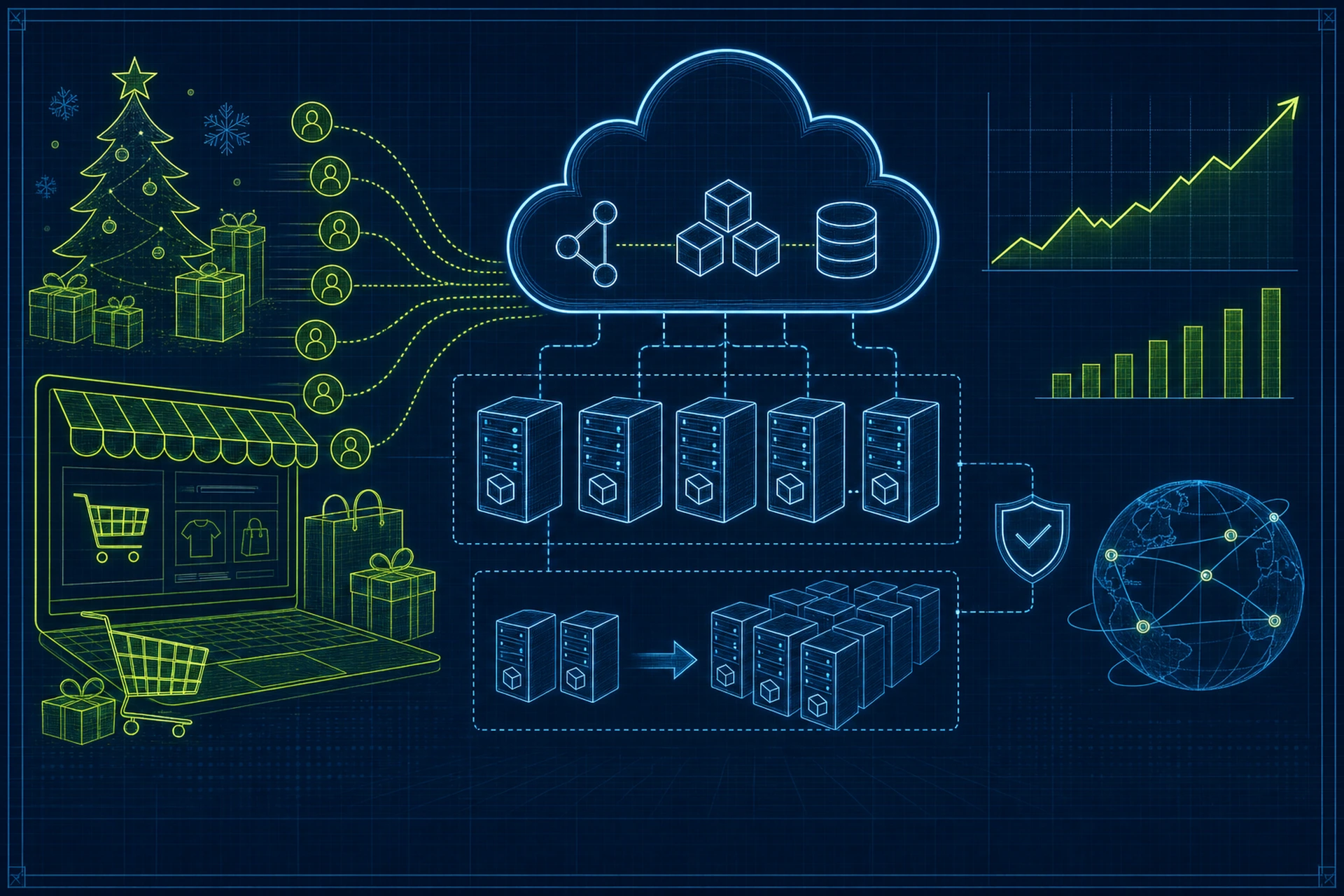
Black Friday hits and suddenly your store has ten times the normal visitors. Carts fill up faster than usual. Checkout pages load slower. Then, right when you need it most, the site goes down. This scenario plays out every year for ecommerce businesses that aren't ready for holiday traffic surges.
The good news is that this problem has a clear solution, and it's not about crossing your fingers and hoping your server holds up. It's about understanding how cloud hosting for business actually handles sudden spikes in demand, and setting your store up to take advantage of that.
Why Holiday Traffic Breaks Traditional Setups
A typical website runs on fixed resources. You pay for a certain amount of CPU, RAM, and bandwidth, and that's what you get, whether you have 500 visitors a day or 50,000.
During normal months, this works fine. Then Black Friday or Cyber Monday arrives, and your traffic can jump by 300% to 1000% in a matter of hours. A server sized for average daily traffic simply doesn't have the headroom to absorb that. Pages slow down, database queries queue up, and eventually the whole thing grinds to a halt.
We've all seen the checkout error messages during a big sale. Most of the time, that's not a coding problem. It's an infrastructure problem.
What Makes Cloud Hosting for Business Different During Surges
Cloud hosting for business is built around a simple idea: resources should scale with demand, not sit fixed at whatever number you guessed when you signed up.
Here's what that actually looks like in practice:
- Elastic resource allocation. When traffic climbs, the underlying infrastructure can allocate more CPU and memory to your site without you manually provisioning a new server.
- Load distribution. Instead of one machine handling every request, traffic gets spread across multiple resources, so no single point becomes a bottleneck.
- Faster recovery from spikes. If something does slow down, cloud environments typically recover and redistribute load much faster than a single fixed server would.
This is the core reason cloud hosting for business has become the default choice for stores that expect seasonal spikes. You're not paying for a server sized for your worst-case day all year round. You're paying for something that flexes when it needs to.
Real-World Example: A Mid-Size Store on Black Friday
Picture a home goods store that normally gets 2,000 visitors a day. On Black Friday, that number jumps to 18,000, mostly within a four-hour window tied to an email promotion.
On a fixed shared hosting plan, this store would likely see checkout timeouts, slow product pages, and possibly a full outage right as the promotion peaks, which is exactly the worst time for a website to fail.
On a cloud-based setup with proper resource scaling, that same traffic gets absorbed. Product pages still load quickly. Checkout still processes orders. The store doesn't lose the sale because the infrastructure didn't buckle under pressure.
This isn't a hypothetical. It's the exact pattern that plays out across thousands of ecommerce sites every holiday season, and the difference between the two outcomes usually comes down to hosting architecture decided months earlier.
Preparing Your Store Before the Surge Hits
Test Before the Season Starts
Don't wait until Black Friday week to find out if your setup can handle a spike. Run a load test in October or early November that simulates several times your normal traffic. This gives you time to fix problems before they cost you sales.
Watch Your Database, Not Just Your Server
A lot of ecommerce slowdowns during traffic surges trace back to the database, not the web server itself. Product searches, cart updates, and inventory checks all hit the database repeatedly. If it's not optimized, that's often where the bottleneck actually lives.
Cache Aggressively, But Carefully
Caching product pages and category listings can dramatically reduce the load on your server during a surge. Just make sure your caching setup doesn't serve stale inventory numbers or outdated prices during a flash sale. We've covered this balance in more detail in how to set up Redis caching on your server without breaking anything.
Have a Monitoring Plan, Not Just a Hosting Plan
Even with good infrastructure, you want visibility into how your site performs in real time during a surge. Response time creeping up is often the first warning sign, well before anything actually breaks. If you're evaluating your setup for uptime monitoring and alerts, our monitoring overview covers what to track.
Cost Considerations Business Owners Often Miss
One thing that surprises a lot of store owners: scalable cloud resources don't mean you're paying peak-season prices all year long. Well-structured cloud hosting for business is priced so you're not overpaying in the quiet months just to be ready for the busy ones. That's a very different cost model than buying a bigger dedicated server upfront and having it sit half-idle for eleven months.
We wrote about this pricing logic in more detail in cloud hosting pricing models explained for business owners who hate surprises, which is worth a read if budgeting for scale is part of your decision.
The Bottom Line
Holiday traffic surges aren't going away, and they're only getting bigger as more shopping moves online every year. The businesses that come out ahead aren't the ones with the flashiest marketing campaigns. They're the ones whose infrastructure simply doesn't flinch when 10x traffic shows up at once.
If you're still running on a hosting plan sized for an average Tuesday, now is the time to rethink that, well before your busiest weekend of the year arrives. For a deeper look at how this plays out beyond just holiday spikes, see how cloud hosting handles traffic spikes that would crash a traditional server.