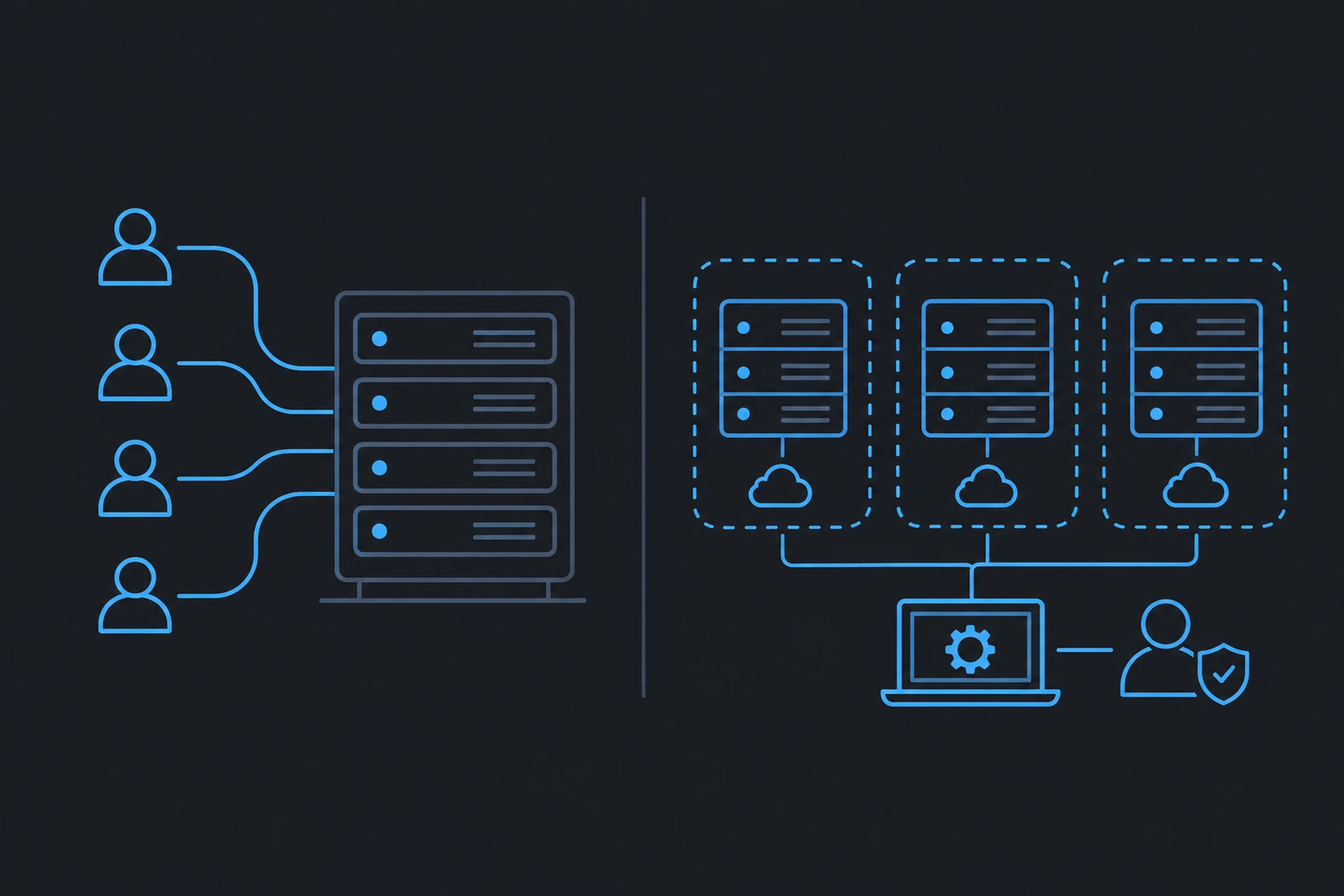
If you've ever watched your site slow to a crawl right after a traffic spike on someone else's blog, you already understand the core problem with shared hosting. You're sharing more than a server. You're sharing its fate.
Managed VPS hosting solves that problem, but not in the way most comparison charts explain it. The real differences show up in daily operation, not just specs on a page. Let's look at what actually changes when you move from shared hosting to a managed VPS.
You Stop Sharing Resources With Strangers
On shared hosting, your site lives on the same physical server as dozens or hundreds of other websites. CPU, RAM, and disk I/O all come from the same pool. If another site on that server gets hit with a traffic surge or runs a bloated plugin, your site pays the price too, even though you did nothing wrong.
With managed VPS hosting, you get your own slice of server resources, walled off from other accounts. A noisy neighbor can't eat your CPU cycles or fill up your shared disk queue. Your site's performance depends on your site's traffic, not everyone else's.
Why This Matters More Than People Expect
This isn't just about avoiding occasional slowdowns. It's about predictability. When you're trying to diagnose a performance issue, shared hosting gives you almost no way to tell if the problem is yours or someone else's. On a VPS, if something's slow, you can actually investigate it and fix it.
Root-Level Configuration Without Root-Level Headaches
Shared hosting locks you into whatever PHP version, server software, and configuration the host decided works for the masses. Want a specific PHP extension? A custom Nginx rule? A different caching setup? Too bad. You're stuck with the lowest common denominator.
A VPS gives you a full server environment that can be tuned to your actual application. That flexibility is why developers and growing businesses move to VPS hosting once their needs get specific. The catch is that someone has to manage that flexibility responsibly, which is where the "managed" part earns its keep. On a good managed VPS, your provider handles the server-level configuration, security patches, and software updates, so you get the control without having to babysit a Linux server yourself.
We've written before about why managed VPS hosting tends to be the sweet spot for growing web projects, and this flexibility-without-burden tradeoff is exactly why.
Security Isolation Changes the Risk Calculation Entirely
Shared hosting environments have a structural security weakness: if one account on the server gets compromised, a poorly configured server can let that breach spread to neighboring accounts. It doesn't happen constantly, but it happens often enough that security researchers treat shared hosting as a meaningfully higher-risk environment.
A VPS isolates your environment at the operating system level. Your site's vulnerabilities are your own, and so is your protection. That matters a lot if you handle customer data, process payments, or just can't afford the reputational hit of a breach that started somewhere else entirely.
For a deeper look at how security layers stack up at the hosting level, see our overview of website security protection.
Scaling Without Starting Over
Shared hosting plans scale by upselling you to a bigger shared plan, which often just means a bigger pool of the same shared problems. VPS hosting scales by giving you more dedicated CPU, RAM, and storage, resources that are actually yours to use.
This matters for anyone planning growth. A store expecting a holiday sales spike, a SaaS product onboarding more users, or a content site that's about to get featured somewhere big, all of these benefit from a hosting setup that can grow without a full migration.
What "Managed" Actually Adds to the VPS Equation
A raw, unmanaged VPS gives you root access and leaves everything else up to you: updates, firewall rules, backups, monitoring, and troubleshooting at 2am when something breaks. That's a full-time job most business owners and developers don't want.
Managed VPS hosting keeps the resource isolation and configuration flexibility of a VPS, but puts a team behind the parts you'd rather not handle yourself. We run automatic daily backups and keep an eye on uptime around the clock, so a server hiccup gets caught and fixed long before it becomes a customer-facing problem. That combination, dedicated resources plus hands-on management, is really the whole point.
If you want to know exactly where that line sits between what's handled for you and what still needs your input, we covered it in detail in Managed VPS Hosting: What's Actually Included and What Still Requires Your Attention.
A Practical Way to Decide
Ask yourself these questions:
- Has your site ever slowed down for no reason you could find?
- Do you need specific server software or configurations your current host won't support?
- Would a security incident on someone else's site worry you if it could spread to yours?
- Are you planning growth that your current plan can't comfortably absorb?
If you answered yes to more than one of these, shared hosting is probably holding you back more than you realize. Managed VPS hosting isn't about having more server for its own sake. It's about having a server that behaves predictably, scales when you need it to, and doesn't put your business at the mercy of someone else's mistakes.
The Bottom Line
Shared hosting and managed VPS hosting solve different problems. Shared hosting is built for simplicity and low cost when your needs are minimal. Managed VPS hosting is built for control, isolation, and growth, without forcing you to become a server administrator to get it. For a site that's starting to matter to your business, that difference is worth paying attention to before a slowdown or security scare forces the decision for you.