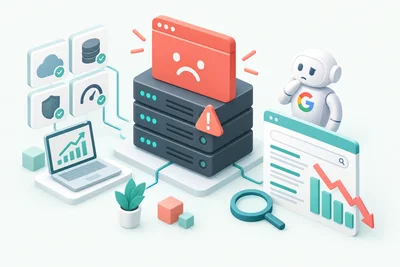
Here's something most site owners don't think about until it's too late: Google doesn't just judge your site by what it sees today. It judges you by the pattern of what it has seen over months and years. Uptime isn't a one-time checkbox. It's a track record, and track records compound.
Think of it like a credit score. One missed payment won't ruin you, but a long history of reliability opens doors that a single good month never will. Search engines treat your site's availability the same way: trust builds slowly, and it pays off in ways that are hard to reverse-engineer from a single ranking factor.
Why Search Engines Reward Consistency, Not Just Snapshots
Googlebot visits your site on a schedule based on how important and how reliable it thinks you are. If it crawls your homepage and gets a timeout or a 500 error, it logs that. One bad crawl won't tank you. But if it happens repeatedly, Google adjusts its expectations. It starts to see your server as unreliable infrastructure, and it crawls accordingly: less often, more cautiously, and with lower confidence in what it finds.
This is the part people miss when they think about website uptime for SEO. It's not just about losing a sale during the ten minutes your site was down. It's about what that outage tells a crawler that remembers every visit it's ever made to your domain.
The Compounding Effect of a Clean Record
Sites with a long history of stable uptime tend to get crawled more frequently and more deeply. That matters because frequent crawling means faster indexing of new content, quicker recognition of updates, and a search engine that's more willing to give you the benefit of the doubt when something looks slightly off (like a temporary spike in load time).
On the flip side, a site with a spotty history has to work harder to earn that same trust back. Even after the uptime issues are resolved, there's often a lag before crawl frequency and indexing speed return to where they were. We've touched on this pattern before in how frequent downtime trains Googlebot to visit your site less and index it slower.
What Counts as a Trust-Damaging Outage
Not every blip matters equally. A few things determine how much damage an outage does to your standing:
- Duration: A 90-second hiccup during a deploy is very different from a four-hour outage.
- Frequency: One outage in a year is noise. One outage every month is a pattern.
- Timing: Outages that happen right when Googlebot tries to crawl you are worse than ones that happen between crawl visits.
- Error type: A 503 that correctly signals "temporarily unavailable" is handled more gracefully than a site that just hangs or returns malformed responses.
If you want a deeper breakdown of how specific error codes play into this, we covered it in why 503 errors hurt your SEO more than most other technical issues combined.
How Uptime Trust Shows Up in Real Rankings
You won't find a single line item in Google's documentation that says "uptime score: 98%." It's indirect. Reliable uptime leads to more frequent, deeper crawling, which leads to fresher indexing, which leads to your pages showing up accurately in search results sooner. Unreliable uptime leads to the opposite chain reaction, and it happens quietly in the background while you're focused on content and backlinks.
This is also why two sites with nearly identical content can perform differently in search. The one with a longer track record of staying online tends to win ties. Search engines are risk-averse. Given two similar options, they'll rank the one they trust not to disappear on a user.
User Signals Reinforce the Pattern
Downtime doesn't just affect crawlers. It affects the humans who land on your site from search results and get an error page instead. That creates a bad experience, a quick bounce, and sometimes a repeat visitor who never comes back. Over time, these behavioral signals feed back into how search engines evaluate your domain's overall quality, adding another layer to the compounding effect.
Building an Uptime Track Record That Works For You
The good news is that this is one of the more fixable parts of SEO. You don't need to guess at algorithm updates or chase backlinks. You need infrastructure that stays online, consistent monitoring so you know the moment something goes wrong, and a process for fixing issues before they turn into a pattern.
Monitoring is the piece most site owners skip until after their first bad outage. A good uptime monitor checks your site from outside your own network at regular intervals, and alerts you the moment something fails, so you can respond in minutes instead of finding out from a drop in traffic three days later. You can read more about setting this up properly in our overview of uptime monitoring and alerts.
Hosting matters here too. A server under-provisioned for your traffic, or one running on hardware without redundancy, is going to have more outages no matter how well you've optimized your code. This is part of why we treat server health monitoring as a core piece of managed hosting rather than an upsell. If you're evaluating your current setup, it's worth checking our VPS hosting plans to see how resource allocation and redundancy are handled.
Backups play a supporting role too. When something does go wrong, whether it's a bad plugin update or a failed migration, having a fast, reliable way to restore your site means the difference between a five-minute blip and a multi-hour outage that Google notices. We go over this in our backups overview.
The Takeaway
Uptime isn't a one-time fix you check off a list. It's a long game. Every hour your site stays reliably online adds a small deposit to an account that search engines are quietly tracking. Every outage withdraws from it, and the withdrawals seem to cost more than the deposits earn. If you want your SEO efforts in content and links to actually pay off, start by making sure the foundation, your uptime, is something search engines can trust without hesitation.