Most business owners spend a lot of time thinking about their website's design, their content strategy, their marketing funnel. Rarely do they spend much time thinking about their hosting. And honestly? When things are working, that's completely fine.
But here's the thing: the reason things are working — often silently, invisibly — is because of what's happening at the infrastructure level. Managed web hosting is one of those investments that doesn't announce itself. It just holds everything together.
This post is about understanding what that actually means in practice, and why the businesses that grow reliably tend to have this piece sorted out early.
What Makes Managed Web Hosting Different from Regular Hosting
With standard shared hosting, you rent space on a server. That's mostly it. Security patches, performance tuning, server configuration, uptime monitoring — those are largely your problem, or they're handled so generically that they barely count.
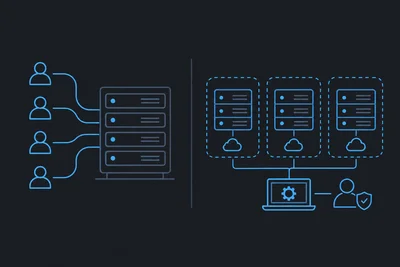
Managed web hosting flips that model. The technical operations of running your server are handled for you, by people who do this all day. That includes everything from keeping the server software up to date, to monitoring for threats, to making sure your site loads quickly under real-world traffic conditions.
Think of it like renting an apartment versus hiring a property manager. One gives you a key and wishes you luck. The other makes sure the heating works, the roof doesn't leak, and someone shows up when something breaks.
The Day-to-Day Difference Is Bigger Than You'd Expect
The practical gap between managed and unmanaged hosting usually doesn't show up on a quiet Tuesday. It shows up during a traffic spike, a security incident, a botched plugin update, or the moment a search engine flags your site as slow.
Those are the moments that define whether a business loses revenue or shrugs it off. And that's where the managed layer earns its keep.
The Real Reasons Growing Businesses Choose Managed Hosting
They're Not Paying for Servers — They're Buying Back Time
The developers and business owners who choose managed web hosting aren't necessarily bad at server administration. Many of them are quite good at it. But they've done the math.
Every hour spent configuring a firewall rule, chasing down a memory leak, or manually triggering backups before a site update is an hour not spent on the work that actually grows the business. Managed hosting isn't a shortcut — it's a smart allocation of energy.
When your hosting environment runs itself, you stay focused on what matters.
Uptime Isn't Just a Stat — It's Revenue
A lot of hosting providers throw around uptime percentages. 99.9% sounds great until you realize that's about 8 hours of downtime per year. For an e-commerce store, that could mean thousands in lost sales. For a service business, it could mean a client who never comes back.
Managed hosting providers actively monitor server health — not just whether a site responds to a ping, but whether it's performing well, whether resources are being strained, whether something is trending in the wrong direction before it becomes an outage. That proactive approach is one of the most valuable things you're getting.
Security Without the Sleepless Nights
Cybersecurity threats don't take weekends off. Bots scan for vulnerabilities constantly. Malicious traffic probes for open doors around the clock. For a business owner without a dedicated IT team, this is genuinely terrifying — or it would be, if they knew how much of it was happening.
A well-run managed hosting environment handles most of this at the server level, before it ever reaches your application. Server firewall, bot filtering, traffic analysis — these aren't things you should need to configure yourself. They should just be part of the environment you're operating in.
Backups That Actually Work When You Need Them
Here's a scenario that plays out more than anyone wants to admit: a developer pushes an update, something breaks badly, and the site goes down. The business owner asks about the backup. The backup either doesn't exist, is weeks old, or was stored on the same server that's now the problem.
Automatic, scheduled backups stored separately from your live environment aren't a luxury — they're table stakes. We run backups on a regular schedule and let you restore at the file level or the full database level, so recovering from something that goes wrong is a matter of minutes, not a full-day emergency. That peace of mind is hard to put a price on, but it's very easy to notice when it's missing.
Why This Matters Especially for Smaller Teams
Enterprise businesses can afford dedicated infrastructure teams. They have SREs, DevOps engineers, security specialists. For everyone else — the small business, the growing agency, the lean startup — managed web hosting is how you get a comparable level of reliability without hiring an ops team.
This is one of the reasons managed hosting has quietly become the default choice for serious online businesses that don't want to babysit their infrastructure. It's not about being too small to handle the technical side. It's about recognizing that handling it yourself has a real cost, and that cost often isn't worth paying. If you're still weighing the tradeoffs, the hidden costs of cheap shared hosting are worth understanding before you commit to a plan.
Scaling Without Rearchitecting Everything
One often-overlooked advantage of managed hosting is what happens when your traffic grows. On cheap shared hosting, a traffic spike usually means slowdowns, errors, and frustrated visitors at exactly the moment you most want to impress them.
Managed environments are set up to handle growth more gracefully. Resources are monitored in real time. When something starts to strain, you get visibility into it early — not after the damage is done. That kind of operational awareness is built into the service, not something you have to wire together yourself.
Choosing a Managed Hosting Provider: What to Actually Evaluate
Not all managed hosting is created equal. When you're evaluating providers, look past the marketing language and ask practical questions:
- What exactly is managed? Does "managed" mean they patch the OS, or does it also include application-level support, security monitoring, and performance optimization?
- How are backups handled? Are they automatic? How often? Are they stored off-server? Can you restore a single file, or only the whole thing?
- What does support actually look like? Real human support with server knowledge is very different from a help desk that escalates everything and emails you back in 48 hours.
- Is monitoring proactive or reactive? Are they watching your server before something breaks, or only responding after you report a problem?
- Can you see what's happening? Good managed hosting gives you visibility — real-time dashboards, uptime history, resource usage — so you're never flying blind.
For a deeper look at how to separate genuinely great providers from merely adequate ones, this breakdown of what separates good from great managed hosting covers the questions worth asking.
The Bottom Line
Managed web hosting doesn't make headlines. It's not exciting to talk about at a dinner party. But it's one of the most consequential decisions you make when building an online business, because it determines whether your infrastructure is a foundation or a liability.
The businesses that scale without dramatic growing pains usually have this sorted out quietly, early. They're not heroically managing servers at midnight. They're building their product, serving their customers, and trusting that the infrastructure underneath them is doing its job.
That trust has to be earned by the host. Make sure yours has earned it.