A data center goes down in one region. Somewhere else in the world, your website keeps loading like nothing happened. That's the promise of multi-region hosting, and for businesses that can't afford downtime, it's quickly becoming less of a luxury and more of a baseline expectation.
If you've ever watched your site go dark because a single server or single data center had a bad day, you already understand why this matters. Let's look at what multi-region setups actually do, and how they fit into a broader strategy for reliable cloud hosting for business.
What Multi-Region Hosting Actually Means
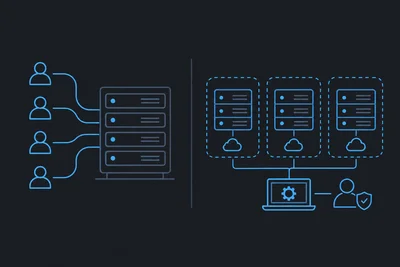
Multi-region hosting means your website or application runs across servers located in more than one geographic area, instead of living on a single machine in a single data center. If one region has a power outage, a network failure, or a hardware issue, traffic gets routed to a healthy region instead.
Think of it like having two bakeries instead of one. If the oven breaks in one location, the other one keeps serving customers. Nobody outside the business even notices there was a problem.
This is different from simply having a backup server sitting idle. In a proper multi-region setup, the failover happens automatically and quickly, often within seconds, so your users barely feel the disruption.
Why Single-Region Hosting Is a Bigger Risk Than It Looks
Most small and mid-sized businesses start on a single server in a single location. That's completely normal, and for many sites, it works fine for years. But single-region hosting has one obvious weak point: if that region has a problem, your site has a problem too.
Regional outages happen more often than people assume. Causes include:
- Power grid failures affecting an entire data center
- Network routing issues between the data center and the rest of the internet
- Natural events like storms or flooding in that specific area
- Maintenance mistakes or hardware failures at the provider level
None of these are common on any given day. But over the lifespan of a growing business, the odds catch up. And when they do, a single-region setup means your entire online presence goes with it.
How Failover Actually Works Behind the Scenes
The mechanics of multi-region hosting come down to two things: replicated infrastructure and smart traffic routing.
Your application and data get mirrored across regions, so there's always a current copy running somewhere else. Then, a routing layer, often built on DNS or a global load balancer, constantly checks the health of each region. The moment one region stops responding correctly, traffic gets redirected to the next healthy region.
This is why DNS configuration matters more than people realize. Health checks, low time-to-live values, and proper failover records all play a role in how fast that switch happens. We touched on the technical side of this in what crawl budget has to do with your hosting, but the same DNS principles apply directly to failover speed. For a deeper look at managing this correctly, see our DNS management overview.
Database Replication Is the Hard Part
Serving static pages from multiple regions is relatively simple. The real challenge is keeping databases in sync across regions without introducing lag or conflicting writes. This is where a lot of DIY multi-region attempts fall apart.
Businesses running this themselves often end up with either eventual consistency issues (where one region briefly shows outdated data) or expensive, complex replication setups that need constant tuning. It's one of the reasons multi-region architecture tends to be handled better by hosting providers who've already solved these problems at scale, rather than built fresh for every client.
What This Means for Real Businesses
Let's put some numbers on it. If your online store makes $500 an hour on average and your hosting goes down for three hours during a regional outage, that's $1,500 in lost sales, not counting the customers who don't come back. For a SaaS product with monthly recurring revenue, an extended outage can trigger cancellations and support tickets that cost far more than the downtime itself.
Multi-region hosting doesn't eliminate every possible failure. But it removes the single biggest point of failure: one location going dark and taking your whole business with it.
Who Actually Needs This
Not every website needs multi-region redundancy. A local bakery's brochure site can usually tolerate occasional downtime without real damage. But it's worth seriously considering if you run:
- An ecommerce store that processes orders around the clock
- A SaaS product with paying customers who expect uptime
- A business where downtime directly and immediately costs revenue
- An application serving users across multiple continents, where latency also matters
If any of those describe your business, multi-region hosting stops being a nice-to-have and starts being basic risk management.
Monitoring Is What Makes Failover Actually Work
None of this matters if nobody notices when a region goes down. Automated failover depends entirely on continuous health checks catching the problem within seconds, not minutes. Good uptime monitoring is what triggers the switch in the first place, and it's also how you get alerted if something still slips through.
We also recommend pairing multi-region setups with solid backup practices. Redundancy protects you from regional outages, but backups protect you from data mistakes, bad deployments, and everything else that redundancy alone doesn't cover.
If you're planning your infrastructure and weighing whether multi-region hosting fits your budget and risk tolerance, we covered some of the broader decision-making in the business case for moving to cloud hosting before you actually need to.
The Takeaway
Outages are rarely a question of if, they're a question of when and how badly they hurt. Multi-region hosting won't make your business immune to every problem, but it removes the scenario where one data center's bad day becomes your business's bad week. If your revenue depends on your site staying up, it's worth asking your host directly how their failover actually works, not just whether they offer it.