Most business owners spend hours choosing the right website, logo, and brand colors. Then they spend about four minutes picking an email provider.
That's a problem — because your business email hosting choice quietly shapes things you probably haven't thought about: your deliverability, your team's productivity, your security posture, and even how professional you appear to customers and partners.
Here's what's actually at stake when you pick where your email lives.
Business Email Hosting and Your Sender Reputation
Every email you send carries a reputation score — and that score is tied directly to the infrastructure your email runs on.
When you use a shared or low-quality email host, you're often sharing IP addresses with hundreds or thousands of other senders. If even a handful of them send spam, your emails start landing in junk folders too. You didn't do anything wrong. You're just a neighbor in a bad building.
Good business email hosting providers maintain clean IP pools, enforce sending limits, and actively monitor for abuse. That means your emails actually reach the inbox — which is the whole point.
Deliverability isn't glamorous, but it's the difference between a proposal that gets read and one that disappears into a spam folder forever.
Authentication Records: The Part Most People Skip
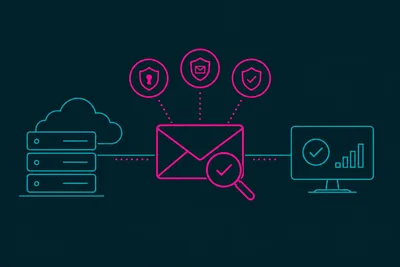
Behind every professional email setup are three DNS records that tell the world your emails are legitimate: SPF, DKIM, and DMARC.
SPF tells receiving servers which mail servers are allowed to send on your behalf. DKIM adds a cryptographic signature to each message so recipients can verify it wasn't tampered with. DMARC ties them together and tells servers what to do when something doesn't match.
Without these, your emails look suspicious — even to people who want to hear from you. Major providers like Google and Microsoft have tightened their requirements significantly, and emails without proper authentication increasingly get rejected outright.
A quality business email hosting provider will either set these up for you automatically or walk you through the process clearly. If your current provider doesn't mention them at all, that's a red flag worth paying attention to.
How Email Hosting Affects Your Team's Day-to-Day
Email isn't just about sending messages. It's a workflow tool. And the hosting environment it runs on determines how well that workflow actually functions.
Uptime and Reliability
If your email goes down, your business goes quiet. Customers can't reach you. You can't send quotes or invoices. Your team can't coordinate. Even a few hours of downtime can cost real money — and real trust.
Cheap email hosting often comes with minimal uptime guarantees. Enterprise-grade business email hosting is built around redundancy: multiple servers, automatic failover, and SLAs that actually mean something.
Storage and Scalability
A solo freelancer and a 20-person agency have very different email needs. The right hosting plan grows with you — adding mailboxes, increasing storage, and handling higher sending volumes without requiring you to migrate everything to a new provider mid-growth.
Migrating email is painful. You lose history, you risk downtime, and you spend days reconfiguring clients and apps. Picking a scalable provider from the start saves you from all of that.
Client and App Compatibility
Your team uses Outlook, Apple Mail, Thunderbird, or a mobile app. Your email host needs to support standard protocols — IMAP, SMTP, and ideally CalDAV and CardDAV for calendar and contact sync — without quirks or limitations.
Some budget providers cut corners here. You end up with email that works fine in a browser but behaves strangely in desktop clients. That friction adds up across a whole team.
Security: Where Email Hosting Choices Have Real Consequences
Email is the number one attack vector for businesses of every size. Phishing, business email compromise, and malware attachments all arrive through the inbox. Your hosting environment is your first line of defense.
Look for providers that include spam filtering, virus scanning, and phishing detection at the server level — before messages even reach your inbox. Some also offer two-factor authentication for webmail access and encryption in transit.
If your email host doesn't actively filter threats, you're relying entirely on your team to catch every suspicious message. That's not a strategy. That's hope.
It's also worth thinking about data residency. Where are your emails stored? In which country? Under which laws? For businesses in regulated industries — healthcare, finance, legal — this isn't a minor detail. It's a compliance requirement.
The Professionalism Signal You Might Be Underestimating
This one is simple but worth saying plainly: the infrastructure behind your email affects how it looks to recipients.
Emails from poorly configured servers sometimes display warnings in Gmail or Outlook — "This message may not have been sent by..." or "Be careful with this message." Even if your email is completely legitimate, a bad hosting setup can trigger those warnings.
On the flip side, a properly configured email environment — clean IPs, valid authentication records, consistent sending patterns — makes your messages look exactly as professional as they should.
First impressions happen before anyone reads a single word you wrote.
What to Actually Look for When Choosing Business Email Hosting
Here's a practical checklist to run through before committing to a provider:
- Uptime guarantee: Look for 99.9% or higher, backed by an actual SLA.
- Authentication support: The provider should support SPF, DKIM, and DMARC — ideally helping you configure them.
- Spam and virus filtering: Server-level filtering, not just client-side.
- Storage per mailbox: Make sure it's enough for your team's actual usage, not just a marketing number.
- Scalability: Can you add mailboxes easily? What happens when your team doubles?
- Protocol support: Full IMAP/SMTP support, plus CalDAV/CardDAV if you need calendar sync.
- Data location: Know where your data is stored, especially if you operate in a regulated industry.
- Support quality: When something breaks, can you reach a real person quickly?
The Bottom Line
Your business email hosting isn't just a utility. It's infrastructure that touches your reputation, your security, your team's productivity, and how customers perceive you every single day.
The good news is that getting it right isn't complicated. You don't need to be a systems administrator. You just need to ask the right questions before you sign up — and not treat it as an afterthought.
Pick a provider that takes deliverability seriously, handles authentication properly, and gives you room to grow. Everything else in your inbox will follow.