You've poured time and money into building your business. You have a website, a logo, maybe even business cards. But when a potential client emails you and sees a Gmail or Yahoo address on your invoice, it quietly undermines all of that work.
A custom domain email address — something like hello@yourbusiness.com — is one of the simplest upgrades a small business can make. And yet, it's one of the most commonly skipped. Let's talk about why that's a mistake, and how to fix it.
What Is Business Email Hosting?
Business email hosting is exactly what it sounds like: instead of using a free consumer email service, you pay a provider to host email accounts tied to your own domain name. You get addresses like sarah@yourcompany.com or support@yourcompany.com rather than yourcompany2024@gmail.com.
The email still works the same way. You can check it on your phone, use a familiar app, and send messages like normal. The difference is entirely in how it looks — and how it makes people feel about your business.
The Trust Problem With Free Email Addresses
Here's something most people don't think about: your email address is often the first real impression you make.
A prospect receives your proposal. Before they even open it, they see the sender. If it reads mikesplumbing1987@gmail.com, something small but real happens in their brain — a flicker of doubt. Is this a real company? Should I trust this person with my home?
Contrast that with mike@mikesplumbing.com. Same person, same proposal, same price. But suddenly it feels official. Professional. Trustworthy.
This effect is well-documented in how people evaluate businesses online. Studies on brand perception consistently show that professional presentation — including something as small as an email address — meaningfully influences purchase decisions. For a small business competing against bigger names, that edge matters.
Why Business Email Hosting Protects Your Reputation
There's a practical reason beyond appearances: email deliverability.
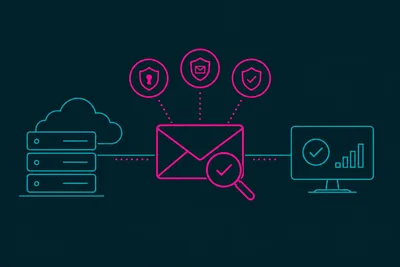
When you send business emails from a custom domain, you can set up proper authentication records — things like SPF, DKIM, and DMARC. These are DNS records that tell receiving mail servers "yes, this email really came from who it claims to come from." Without them, your emails are more likely to land in spam, or worse, get flagged as phishing.
Free email accounts can't give you this level of control. You're at the mercy of Google's or Yahoo's sending reputation, shared with millions of other users. A dedicated business email hosting setup gives you your own reputation to build and protect.
And speaking of DNS — getting your email records right is crucial. Your MX records tell the internet where to deliver your email. Your TXT records handle authentication. If these aren't configured correctly, email simply won't work reliably. If you're managing multiple domains, being able to copy and replicate DNS configurations accurately saves a lot of headaches. (It's one of those behind-the-scenes things a good hosting setup handles cleanly.)
The Credibility Gap Is Bigger Than You Think
Let's put some numbers to this. According to research by Verisign, 65% of consumers consider a company more credible if it communicates from a professional domain email — and over 50% said a company with a domain-based email appears more established than one using a free service.
For small businesses, credibility isn't a nice-to-have. It's often the deciding factor between winning and losing a client — especially when competing against larger, more established brands. A custom email address doesn't cost much, but the credibility it signals is worth far more than its price tag.
Other Real Benefits of a Custom Business Email
You own your email identity
With a free Gmail account, Google owns that address. They can suspend it, apply policy changes to it, or shut it down. With a business email hosted on your own domain, you're in control. Switch hosting providers, change mail clients, set up forwarding — it's your address, and it goes wherever you go.
Easy to scale as your team grows
Right now it might just be you. But someday you'll bring on a second person, then a third. With business email hosting, adding james@yourcompany.com or orders@yourcompany.com is straightforward. You can create role-based addresses like support@ or billing@ that route to the right person — without anyone needing to know whose inbox it really is. If you're thinking ahead about how your setup scales, business email hosting for remote teams covers exactly that challenge.
It looks intentional
Small things signal big things. Using a professional email says: this business is serious, organized, and here to stay. Using a free email says: this might be a side project. Which message do you want to send?
How Much Does Business Email Hosting Actually Cost?
This is where many small business owners are pleasantly surprised. Business email hosting typically runs anywhere from $3 to $10 per user per month, depending on the provider and how much storage you need. Google Workspace starts around $6/month. Microsoft 365 is similar.
For a solo operator, that's less than a coffee per week. For the credibility it buys you, it's arguably the best-value upgrade you can make early in your business.
Some hosting plans also bundle basic email hosting with your domain and web hosting, so it's worth checking what's already included before signing up for a separate service. As this breakdown of business email vs. free Gmail shows, the gap in value is often larger than the gap in price.
Setting Up Your Business Email: The Short Version
The setup process is simpler than most people expect:
- Register your domain if you don't already have one. Something short, memorable, and close to your business name works best.
- Choose an email hosting provider. Google Workspace, Microsoft 365, and Zoho Mail are the most common choices for small businesses.
- Update your DNS records. You'll add MX records pointing to your mail provider, plus SPF and DKIM records for authentication. Your host or domain registrar will walk you through this.
- Create your mailboxes and connect them to your preferred mail app on desktop or mobile.
Most providers offer setup guides that make this a one-afternoon project. You don't need to be technical to get it done.
The Takeaway
If you're still running your business from a free consumer email address, you're leaving credibility on the table. Business email hosting is affordable, easy to set up, and sends an immediate signal that your business is real, professional, and worth trusting.
It won't make you more skilled at what you do. But it will make sure that skill gets judged fairly — not dismissed before you've had a chance to prove it.
Set up your custom domain email this week. It takes a few hours, costs a few dollars a month, and the first time a new client says "I love your email address" — and yes, it does happen — you'll know it was worth it.